


Internal Combustion Engines
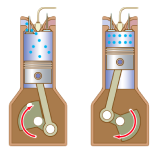
A carbureted internal combustion engine consists of the following parts (a). The fuel mixture burns in the engine’s cylinder (1). The piston (2) in the cylinder is connected to the connecting rod (3). The piston’s linear motion is converted into rotational motion of the crankshaft (5) through the crank arm (4) attached to the connecting rod. A metal flywheel is attached to the crankshaft (b, see diagram). When the piston moves upward, it does not reach the cylinder head, leaving a space between the piston and the cylinder head known as the combustion chamber (6). The cylinder head is connected to two channels equipped with intake (7) and exhaust (8) valves. These valves open automatically in a specific sequence: the intake valve allows the fuel mixture into the cylinder, and the exhaust valve expels the combustion by-products. Besides the valves, there is also a spark plug (9) in the cylinder head. The electric spark generated by the spark plug ignites the fuel mixture.
Internal combustion engines get their name from the fact that the fuel burns inside the cylinder, converting internal energy into mechanical energy. Modern internal combustion engines operate in four strokes.