


Fluid Dynamics (Vortex Effect)
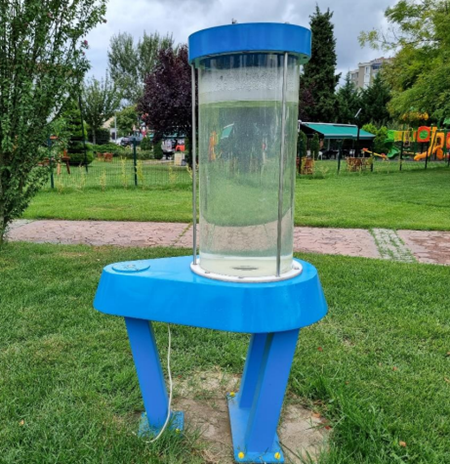
This device demonstrates the movement dynamics of fluids and the formation of vortices. Inside a cylindrical transparent water tank, the liquid is rapidly rotated using a mechanical system. As a result of the rotation, the fluid mass moves outward due to centrifugal force, while the surface of the water lowers in the center, forming a funnel-shaped void — a vortex.
This process allows real-time observation of physical laws such as fluid-fluid and solid-fluid friction, hydrodynamic stability, and pressure differences. Thanks to this device, it is possible to study the mechanism of naturally occurring vortices — for example, when water drains through a pipe or during the formation of hurricanes in the ocean.
The concept of the “vortex” was first observed by ancient Greek philosophers, but its scientific explanation was developed in the 17th century through René Descartes’ vortex theory and later Isaac Newton’s work on fluid mechanics. During the Industrial Revolution, engineers began studying vortex mechanisms to better control water and air flows.