


The Journey of Sound
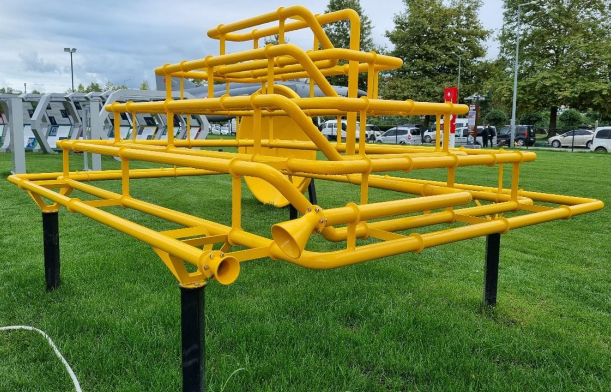
This device demonstrates the movement of sound waves through air at a specific but limited speed. A sound signal sent from one end causes air molecules inside the tubes to vibrate, propagating as a wave. The length and direction of the tubes affect the time it takes for the sound to reach the listener and the quality of the sound.
The speed of sound in air is approximately 343 m/s, but factors such as temperature and humidity can alter this value. When the ear is placed near the device, one can clearly perceive how the sound fades and its tone changes along the path. The conical output section focuses the sound waves, making them easier to hear.
This experiment visually shows that sound does not travel instantaneously, but rather over time. The complex structure of the tubes demonstrates how sound can travel in different directions and interact. It is a valuable experience for understanding acoustics.
The first measurements of sound speed were conducted in the 17th century by Galileo Galilei and Marin Mersenne. More accurate results were obtained in 1738 through experiments by Daniel Bernoulli and other scientists. In the 19th century, the propagation speed of sound in air, water, and solids was extensively studied. Today, modern “Journey of Sound” devices in science exhibitions and open-air museums allow visitors to experience this phenomenon with their own ears.